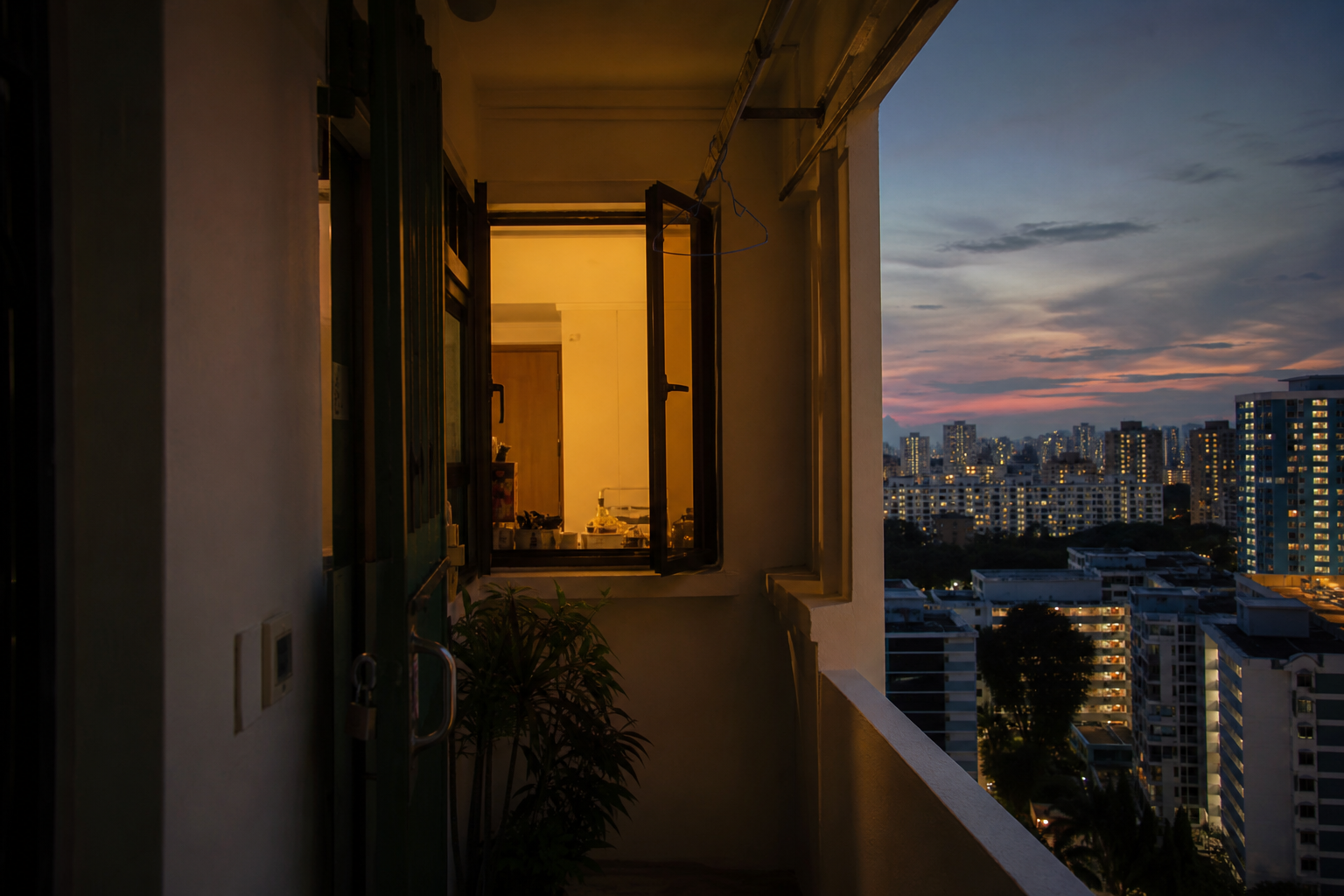
Every evening I carry one thing to the corridor rail: a notebook with a cover soft from use, and a pen that skips if I press too hard. The ritual is not spiritual — no candles, no mantra — just a bargain I made with myself years ago when the flat still felt new and the view still surprised me. One page before the city finishes turning on its lights. No more, no less.
I lean on the eleventh-floor ledge where the paint is slightly rough under my forearms. From here Chin Swee Road is a ribbon with buses on it. The MRT viaduct crosses toward Outram like a sentence half spoken. At dusk the glass of opposite blocks becomes mirrors first, then lanterns as rooms wake inside. I wait for the moment when day and electric light share the frame equally — that is when I open the notebook.
Today the page fills with small inventory: a child’s shoe left outside unit 11-08, a purple orchid on a neighbour’s grilles, the exact shade of the sky between cloud and haze — not blue, not grey, something in between that English handles poorly. I write a line about the hawker centre exhaust rising in a straight column until wind breaks it. I write about the uncle who always smokes by the bin at the wrong hour and how the ember looks like a tiny runway light.
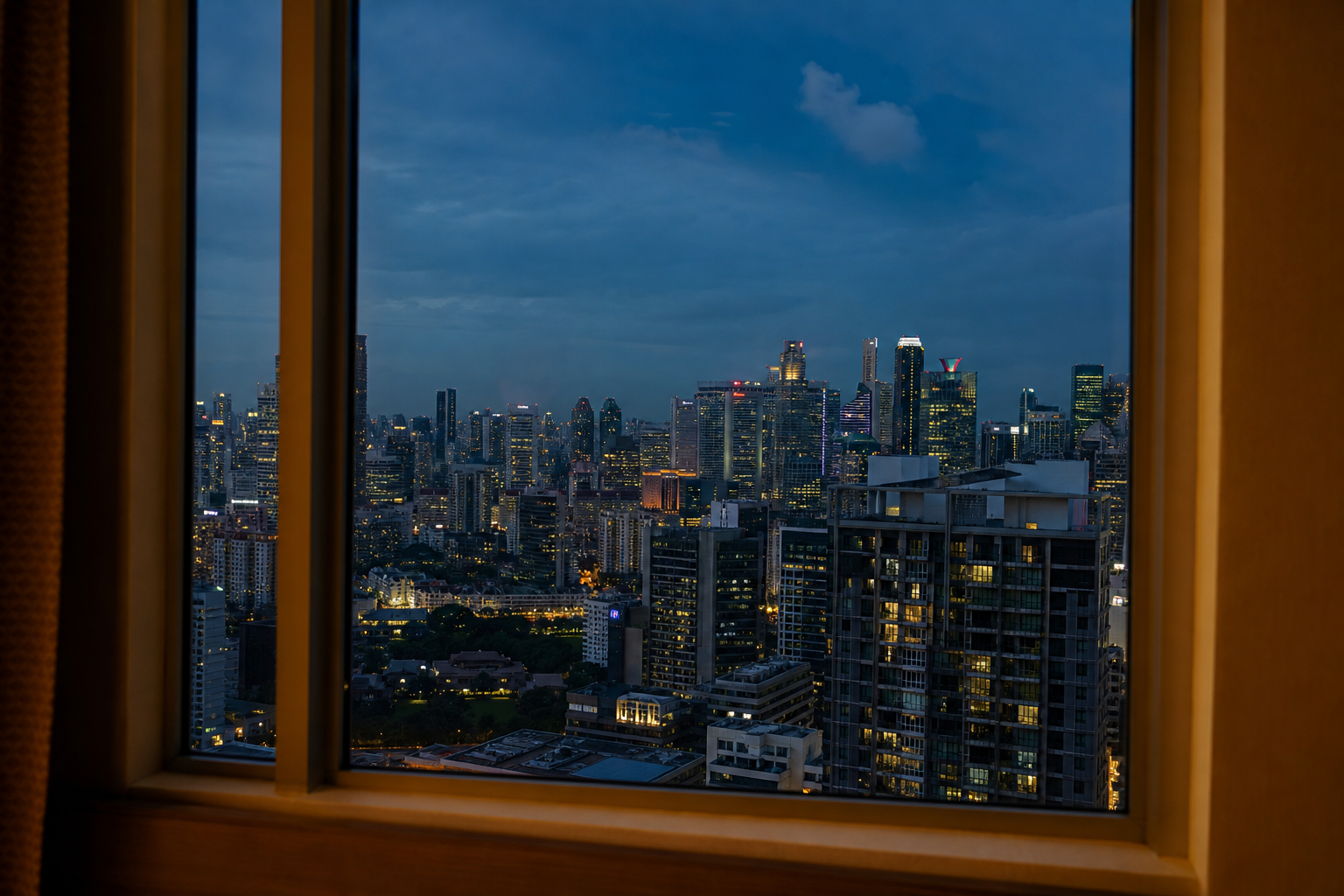
The rule matters because without it I would either never write or write until my hand cramped and the moment passed. One page forces attention. I cannot summarise the whole neighbourhood; I have to choose. Tonight I choose sound: the lift arriving on my floor with a sigh, someone’s rice cooker clicking off, a distant motorbike on Lower Delta. The city is never silent, but at this hour the layers are thin enough to count.
Sometimes the page turns confessional — worry about money, a friendship I have been slow to reply to — and sometimes it stays stubbornly external, a list of colours and movements like I am sketching with words. Both are allowed. What is not allowed, by my own rule, is scrolling on my phone while the notebook waits. The phone stays inside, face down on the kitchen counter, charging like a pet that has been fed.
When the street lamps below click on — not all at once but in a sequence I still cannot predict — I write the last line and close the cover. Tonight it reads: the pane holds the city until I look away. Corny if you read it cold; true if you were standing here. I stay another minute without writing, just looking, because the ritual’s quiet coda is as fixed as the page itself.
Inside again, the flat smells like ginger from soup I left simmering. The notebook goes back to the shelf between a cookbook and last year’s diary. Tomorrow the view will be the same geometry with different details. That is why I keep coming to the rail — not because the city changes dramatically, but because I do, one page at a time, at the hour when the lights prove it.
I wash a bowl. The corridor is empty when I peek out. The page is done.