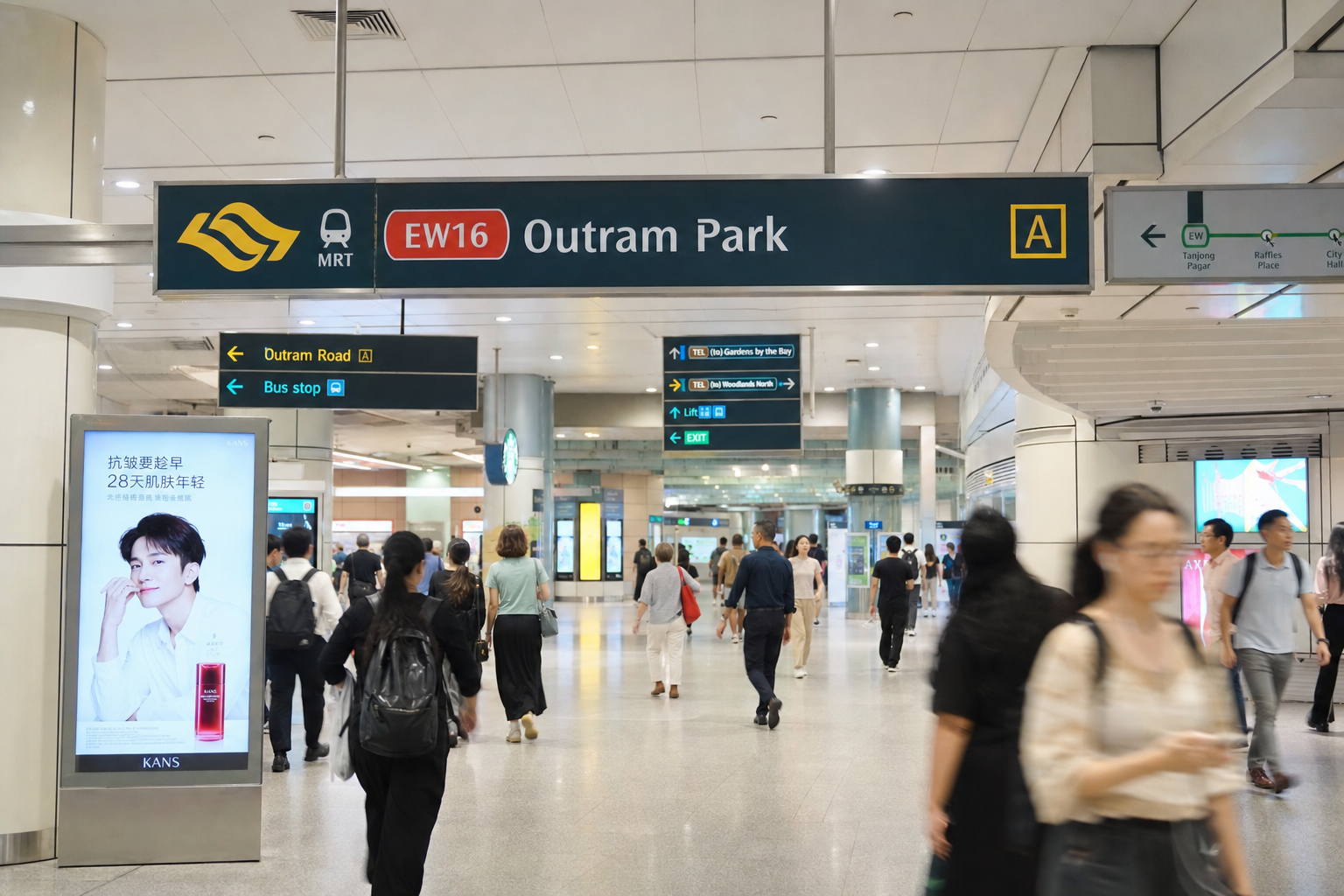
The interchange always looks simpler on the map — coloured lines meeting at tidy angles — than it feels underfoot, where corridors fork and signage repeats itself and everyone walks with the confidence of people who have done this a thousand times. I was changing from the North-East Line to the East-West Line with a bag of books and no urgency, which is how I noticed the woman standing still in the middle of the flow, phone in one hand, paper ticket in the other, eyes on the ceiling as if the answer might be written there.
Commuters parted around her the way water parts around a stone. Nobody rude, just efficient. Singapore efficiency can feel like indifference from the outside; I know because I am usually inside it, marching toward the escalator with my card already in hand. That day I slowed without deciding to, staying one pillar back so I could watch without hovering.
An uncle in a polo shirt doubled back. He had been ahead of me — I remembered his shoes, brown leather worn at the heel — and now he stood beside her, speaking in a mix of English and Mandarin I could not catch whole sentences of. He pointed left, then corrected himself, pointed toward the green-line sign, tapped his own EZ-Link as demonstration. She nodded too quickly, the way people nod when they are still lost but do not want to take more of your time.
He waited. Actually waited, while the crowd moved. He walked her ten steps to the correct corridor mouth — I counted — and only then turned back toward his original direction, which meant he had been heading the other way entirely. The whole exchange took less than two minutes. By the time I reached the escalator they were both gone, swallowed into separate trains.
I thought about how many times I have been that woman, not here perhaps, but in another city’s metro, staring at a map that assumes you already understand north. I thought about how rarely I double back. Not never — I have given directions to tourists at Bayfront, helped someone carry a pram on stairs — but those feel like exceptions I file under good deed and forget. The uncle made it look like the obvious thing to do, which might be the kindest part.
Outram Park at midday is fluorescent and loud: announcements overlapping, shop shutters half down for cleaning, the smell of cleaning fluid from the toilet corridor. None of that changed. The interchange did not become a storyboard for human goodness. A busker two levels up started the same song I always hear there. My train arrived with the familiar rush of cold air.
I got on, found a seat, opened one of the books I had bought at Bras Basah. The title did not stick; what stuck was the uncle’s hand, flat and steady, pointing where the green line begins. I wrote it on the inside cover because I distrust memory and because some scenes deserve a ledge to sit on even if you were only a witness standing by a pillar.
The doors closed. The tunnel darkened. I kept the note — three words: he went back.